The whale shark was already famous for being the world’s largest fish. But now the story is even more interesting: according to a study published in the scientific journal Ecology, it can also make use of plant matter such as floating sargassum, making it the largest known omnivorous animal on the planet.
Yes, the Caribbean giant does more than filter plankton, krill, fish eggs and tiny marine organisms. Scientists discovered that its diet is more complex than previously thought, and that floating Sargassum, together with the small organisms associated with it, may form an important part of what it eats.
And that changes the way we look at this animal. We are no longer talking only about an enormous, peaceful and spectacular shark. We are talking about one of the ocean’s most astonishing creatures.
What is a whale shark?
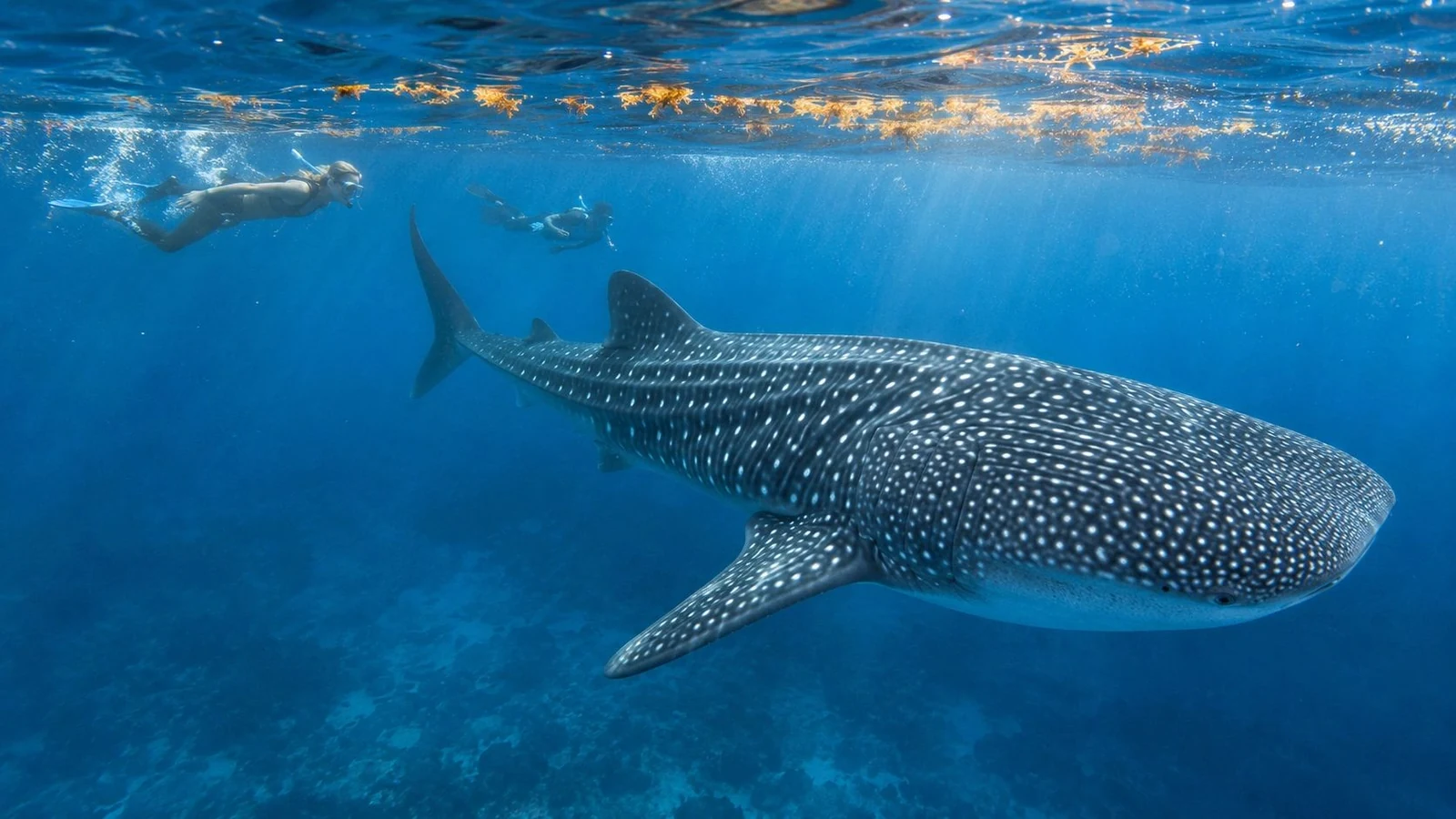
The whale shark (Rhincodon typus) is the largest fish on the planet. Although its name may sound intimidating, it is not a whale, and it does not behave like a shark that is dangerous to people.
It is a filter feeder. It swims slowly with its mouth open and filters huge amounts of water to feed on tiny organisms. Its size is imposing, but its behavior radiates calm.
Watching it swim is like watching a living ship glide past: silent, covered in white spots and moving with an elegance that seems impossible for such a large animal.
The study that changed what we knew
For a long time, whale sharks were thought to feed almost exclusively on small marine animals. But the study “The world’s largest omnivore is a fish”, published in Ecology, analyzed tissue, feces and possible food sources and found signals consistent with an omnivorous diet.
In simple terms: whale sharks do not eat only small animals. They can also make use of marine plant matter, especially floating sargassum.
This does not mean that they come to “clean” beaches or feed on the sargassum piled up on the shore. The accurate point is different: out at sea, while filtering water in food-rich areas, they may ingest and digest some of the sargassum and the tiny life associated with it.
Why do whale sharks come to Quintana Roo?
Whale sharks come to northern Quintana Roo because they find food here.
The area between Isla Mujeres, Isla Contoy, Holbox and Cabo Catoche brings together special conditions: ocean currents, nutrient-rich waters and abundant plankton. That combination makes this part of the Mexican Caribbean one of the world’s most important areas for whale shark sightings.
The Whale Shark Biosphere Reserve in Quintana Roo was created to protect these aggregations north of the Yucatán Peninsula. CONANP describes the area as globally important because of its whale shark concentrations and the high production of plankton that encourages many marine species to gather there.
They are not here by chance. They come because the sea gives them perfect conditions.
When is whale shark season?
Whale shark season in Quintana Roo takes place mainly during the warmer months of the year. According to CONANP information for the Whale Shark Biosphere Reserve, the recommended visiting period runs from May 15 to September 17, 2026.
For visitors to Playa del Carmen, Cancún, Holbox or Isla Mujeres, this period offers one of the best opportunities to learn more about the species and enjoy a unique nature experience.
As always with nature, there are no absolute guarantees. The sea does not have a customer-service department. The presence of whale sharks depends on food, weather, currents, wind and sailing conditions.
That is why it pays to get good information, choose authorized operators and check sea conditions before planning your outing.
Why is it worth seeing one?
Because this is no ordinary excursion. It is an encounter with the largest fish in the world and the largest known omnivorous animal.
You can see photos, videos and documentaries, but nothing compares with being in the water as an enormous, calm, white-spotted silhouette appears and passes close by in absolute peace.
Swimming near a whale shark does not feel like an ordinary tourist activity. It feels like stepping for a few minutes into a scene of real nature, with no filters and no special effects.
Many people consider it a once-in-a-lifetime experience. Not because it is extreme, but because it is profoundly simple: you, the Caribbean Sea and one of the most impressive animals on the planet.
An experience to have at least once
Some things are done for the photo. Other things are lived so they can be remembered.
The whale shark belongs to the second category.
It is not about touching it, chasing it or getting closer than the rules allow. It is about observing it with respect. Understanding that we are visitors in its world. Feeling, if only for a few minutes, the ocean’s true scale.
When you see it pass, you understand that the Mexican Caribbean is not just pretty beaches, white sand and turquoise water. It is a living, complex and powerful ecosystem.
Is it dangerous to swim with whale sharks?
No, as long as it is done properly.
Whale sharks are not aggressive toward people. Their feeding behavior has nothing to do with the classic image of a hunting shark. They are filter feeders that move slowly and look for tiny food near the sea surface.
The truly important thing is to choose carefully. The experience should take place with authorized providers, trained guides and full respect for conservation rules.
Never touch a whale shark, chase it, block its path or try to turn a natural encounter into a private show.
The best photo is the one that does not disturb the animal.
Playa del Carmen, webcams and a good coffee before you set out
If you are in Playa del Carmen, this experience is normally organized as a full-day excursion. Many trips to the sighting areas depart from Cancún, Isla Mujeres or Holbox, so it pays to plan ahead.
Before choosing a beach day or a day at sea, it also helps to check live conditions. On our website, we have gathered Riviera Maya webcams so you can see what the Caribbean looks like before making your plans.
And if you are wondering where to have breakfast in Playa del Carmen before the adventure begins, a stop at an Italian café in Playa del Carmen never hurts. Coffee, freshly baked bread, something quick to take away and you’re ready—because going out to sea on an empty stomach sounds very poetic until the boat starts moving.
What to bring for the experience
To enjoy the day at its best, pack the basics:
- Swimsuit.
- Towel.
- Dry change of clothes.
- Cap or hat.
- Sunglasses.
- Water.
- Underwater camera or a phone with a waterproof case.
- Motion-sickness medicine if you are sensitive to movement.
- Biodegradable sunscreen, always following your operator’s instructions.
Remember that you are entering a natural environment. The experience is worth more when it is lived with respect.
The Mexican Caribbean is much more than a postcard
The whale shark reminds us of something important: the Mexican Caribbean is not just a vacation destination. It is a living system in which currents, plankton, sargassum, fish, turtles, manta rays and whale sharks form part of a natural network far larger than anything we can see from shore.
Sometimes we look at the sea and think only about whether it is blue, whether there is sargassum or whether the beach looks pretty. But extraordinary things are happening beneath the surface.
And the whale shark is one of the most impressive signs of that marine life.
An encounter that changes the way you look at the sea
The whale shark does not need to do anything spectacular to impress you. It does not jump, roar or attack. It simply swims.
And yet seeing one up close can be one of the most powerful experiences in the Mexican Caribbean.
Perhaps that is because it reminds us that nature does not always need speed to be impressive. Sometimes the calm of a giant, clear water and a few minutes of silence are enough to understand that we are looking at something unique.
The season does not last all year. So when the Caribbean opens this window, it is worth getting informed, watching the sea, choosing carefully… and letting yourself be amazed.
A personal recommendation
I have lived in Playa del Carmen since 2013 and, since then, have taken dozens of excursions around the Riviera Maya. Some were unforgettable; others taught me that choosing the right people to go with makes all the difference.
So if you are thinking of experiencing the whale shark, my advice is to do it with a responsible, serious guide who truly respects the sea. I can recommend Marco el Vikingo, someone I trust who knows the area and works with the care an experience like this deserves.
Because seeing a whale shark is not just taking a tour: it is living one of those moments that stays with you.
A.C.