Updated August 6, 2026
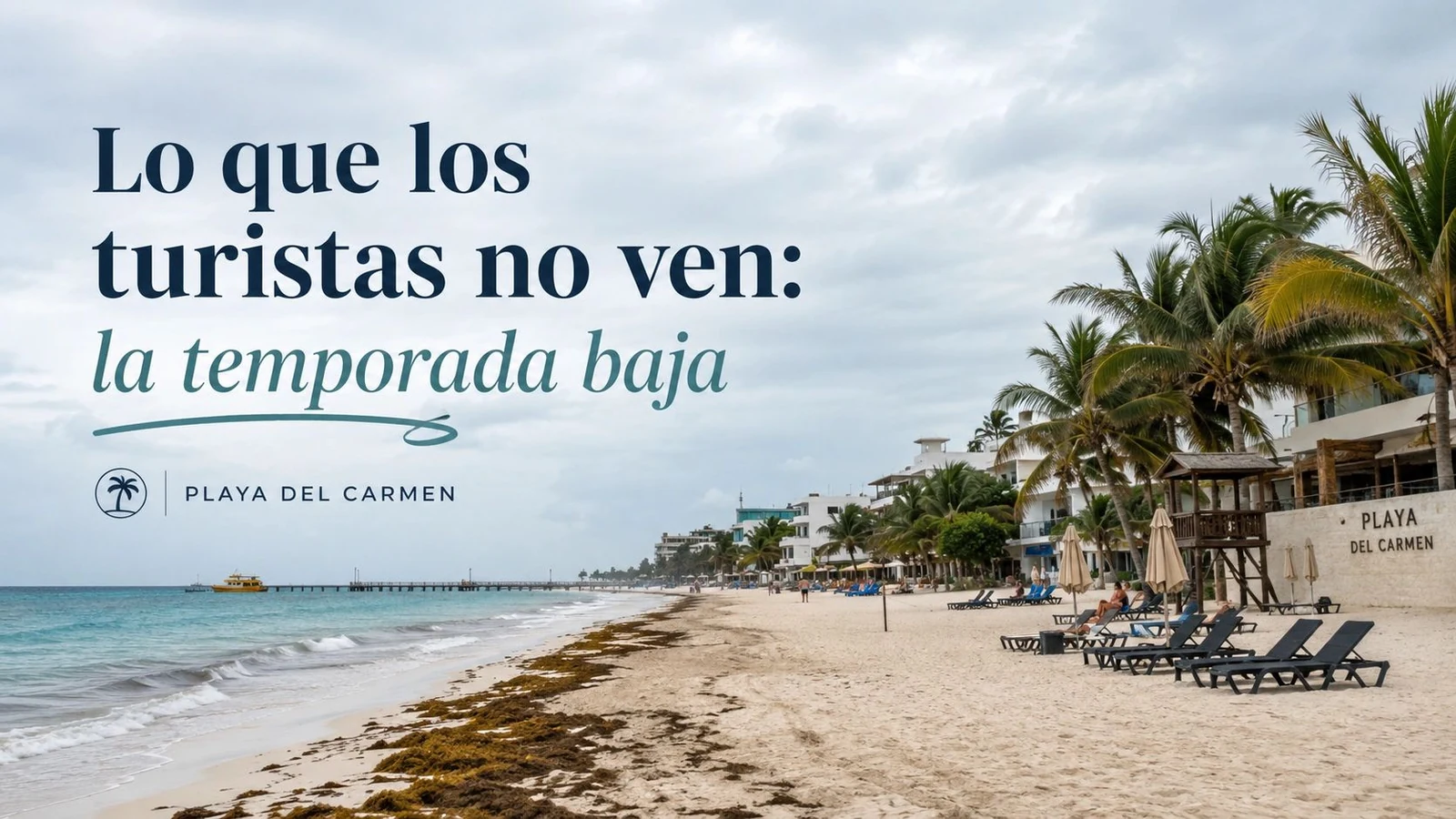
Those of us who live in Playa del Carmen know it: sargassum is no longer an occasional nuisance limited to a few months of the year. It has become a persistent environmental, economic and public-health problem that can affect beaches, tourism and the daily operations of hotels, restaurants and small businesses.
Once again, 2026 demonstrated the scale of the phenomenon. According to the Government of Mexico, 92,782 metric tons were collected in Quintana Roo in 2025, and by July 30, 2026, the figure had already reached 96,151 metric tons. These figures were presented by the Office of the President and reproduced in the official statement issued by the Government of Quintana Roo on July 30, 2026.
In response, the federal government announced a two-stage strategy with a projected investment of 2.6356 billion pesos. The inevitable question is: what does it actually include, how long will it take, and will it be enough to solve the problem—or merely reduce its consequences?
The main change: collect it before it reaches the beach
Until now, most sargassum has been removed after it has already reached the shore. It is the most visible method, but also one of the least efficient: the accumulated macroalgae decomposes, becomes mixed with sand and waste, and is harder to transport and reuse.
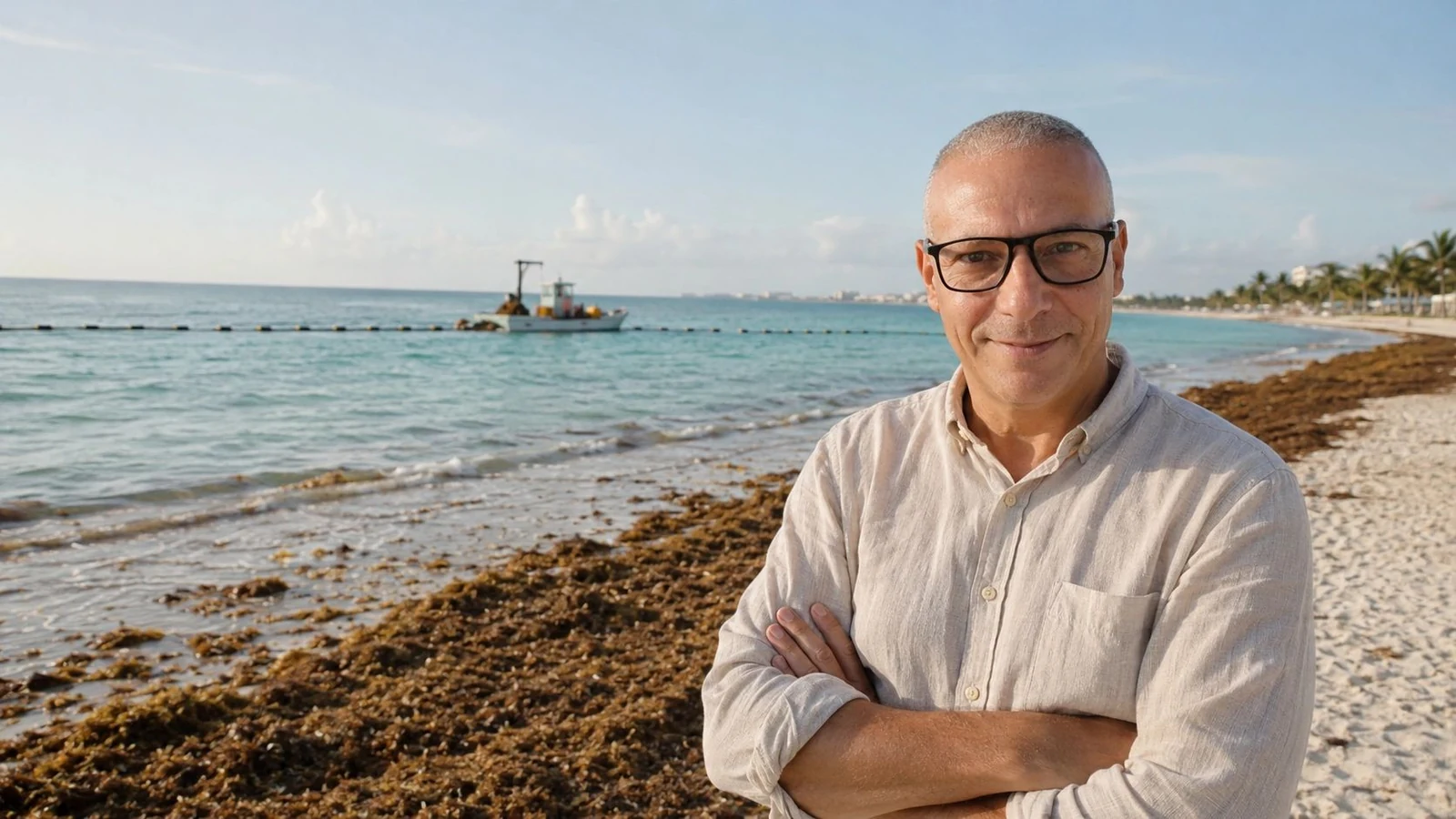
The new approach seeks to reverse that ratio by capturing more sargassum in the open sea and coastal waters before it reaches the beaches. The federal strategy will prioritize Cancún, Playa del Carmen, Puerto Morelos, Tulum and Mahahual, which together represent roughly 40 to 50 kilometers of tourist coastline, according to the official announcement by the Government of Quintana Roo.
This does not mean cleaning the entire ocean. The objective is to detect masses headed toward critical areas and collect them close to shore, where operations can be better controlled and the impact on the biodiversity associated with sargassum in the open sea can be reduced.
What does the federal strategy include?
The project presented by the Government of Mexico includes four lines of action:
- collection in the open sea;
- containment and redirection in coastal waters;
- beach cleanup;
- transportation, final disposal and reuse of the collected material.
To strengthen infrastructure, the government announced new tugboats, coastal sargassum-collection vessels, dynamic barriers, and a monitoring and early-warning system. Official information also indicates plans to considerably expand barrier coverage in the hardest-hit areas. The components and capacity targets appear in the version published by the Government of Quintana Roo.
The idea is to build a complete chain: detect, intercept, collect, transport and provide a safe destination for the sargassum. This final step is essential. Removing it from the sand without an authorized disposal site or a suitable industrial process simply moves the problem from the beach to another part of the region.
First stage: 768.7 million pesos during 2026
The most concrete part of the plan is its first stage. An investment of 768.7 million pesos was announced for 2026 to add two tugboats, six coastal sargassum-collection vessels and more dynamic barriers, as well as to reinforce offshore operations.
The official goal is to raise installed collection capacity from 1,227 to 1,870 metric tons per day. The investment, equipment and target are all expressly set out in the official statement by the Government of Quintana Roo.
It is important to distinguish between the total budget and immediate implementation: the 2.6356 billion pesos represent the projected value of the entire strategy, while 768.7 million pesos is the amount detailed for the first reinforcement stage in 2026. Therefore, not all the announced equipment has already been purchased, built or put into operation.
Second stage: the target of 4,000 metric tons per day
The second stage aims to reach a capacity of 4,000 metric tons per day, a figure close to the average amount that can wash ashore each day during high-intensity periods. That target appears in the official presentation of the federal strategy distributed by the state government.
However, the official announcement reviewed does not provide the same level of detail for the full schedule to contract, build and place all the second-stage equipment into service. Some media reports place the target in 2027, but until a more detailed public contractual or budget schedule exists, it is more prudent to present it as a second-stage objective, not a guaranteed result by a specific date.
Satellite monitoring and early warning
Another pillar is forecasting arrivals. Playa del Carmen’s strategy includes continuous satellite monitoring, daily field inspections and the publication of a beach-by-beach color-coded status report. The municipal government states that this work is carried out in coordination with Semar, UNAM and Conabio, as described in the municipal sargassum strategy for 2026.
At the federal level, a technical working group coordinated by the Secretariat of Science, Humanities, Technology and Innovation is working on monitoring, early warning, biorefineries, health effects and biodiversity. Its statement explains that satellite platforms can estimate the location, quantity and trajectory of sargassum, although accuracy varies by system. Details are available in Secihti Statement 36/2025.
This tool may be less spectacular than a new vessel, but it is essential: without a reasonably accurate forecast, boats end up chasing sargassum instead of intercepting it.
What is Playa del Carmen doing?
Playa del Carmen began 2026 with unusually early arrivals. By February 11, the municipal government reported that 1,288 metric tons had already been removed, while more than 30,000 metric tons had been collected throughout 2025—the highest volume in the past decade. Both figures come from the municipal statement dated February 11, 2026.
The municipal plan included:
- expanding the barriers from 2.5 to five kilometers;
- daily satellite monitoring and beach-by-beach status reports;
- three sargassum-collection vessels and two smaller boats operated by Semar;
- 15 collection points managed by Zofemat;
- specialized machinery and coordination with the hotel sector;
- public participation through the Reto Sargazo 2026 program.
On August 3, 2026, the municipal government confirmed that all five kilometers of barriers had been installed between Playa Fundadores and Punta Esmeralda. The confirmation appears in the official statement by the Government of Playa del Carmen.
The barriers are not watertight walls. Their purpose is to contain, slow or redirect floating masses toward areas where boats can collect them. Strong waves or extraordinary volumes can overtop them, so their effectiveness depends on maintenance, currents and the speed of collection.
From waste to raw material
The most ambitious part is transforming sargassum into biogas, biofertilizers, biochar, bioplastics or other industrial inputs. The Government of Quintana Roo reported an investment of 40 million pesos in an initial biogas pilot plant combining sargassum with sludge from treatment plants; the figure was presented during the presidential press conference of August 15, 2025.
In parallel, Secihti is working on the design, construction and pilot-scale validation of a zero-waste biorefinery in Quintana Roo. The scientific authority makes clear that its technical, environmental, operational and economic feasibility must still be evaluated. In other words, it is a promising line of development, but not yet a fully established industrial solution. Official source: Secihti.
Reuse is not automatic either. Before sargassum can be used in agriculture, cosmetics, food, construction or energy, its composition, contaminants, salt content and traceability must be analyzed. The same federal technical working group maintains dedicated groups on regulation, raw-material assurance, emissions, health and biodiversity.
Why can’t all the sargassum be removed from the ocean?
In the open sea, sargassum is part of the ecosystem and serves as shelter, a feeding area and a breeding ground for various species. Collection must therefore focus on masses that pose a risk of washing ashore, without attempting to indiscriminately eliminate the macroalgae from the Atlantic.
The federal technical working group expressly recognizes the need to study associated flora and fauna, water quality and ecosystem vulnerability before expanding reuse operations. Source: Secihti.
So, will the plan work?
The 2026 strategy is more comprehensive than merely removing sargassum from the sand. It combines prevention, monitoring, offshore collection, barriers, coastal cleanup and reuse projects.
But there is still no solution capable of guaranteeing permanently sargassum-free beaches. Volumes change rapidly with the wind, currents and ocean conditions. Effectiveness will also depend on very specific factors: vessels actually being available, barriers in good condition, trained staff, sufficient transportation, and authorized treatment or disposal sites.
To seriously assess the strategy, the government should publish at least four indicators on a regular basis:
- metric tons intercepted at sea;
- metric tons removed from beaches;
- the amount sent for final disposal and the amount actually reused;
- the collection, transport and treatment cost per metric ton.
Without these data, it will be difficult to distinguish between a structural improvement and a larger operation that still acts mainly after the damage has already reached the coast.
What changes for residents and visitors?
Sargassum can shift location within a few hours and does not reach the entire coastline with the same intensity. Before choosing a beach, it is worth checking official status reports, recent images and live cameras, which we make available on our website.
The most important advance is that the phenomenon is beginning to be treated as a permanent public policy issue, rather than as a surprise that returns every spring. The next step will be to show that the announced resources become operational equipment, greater collection at sea and environmentally safe final disposal.
A.C.