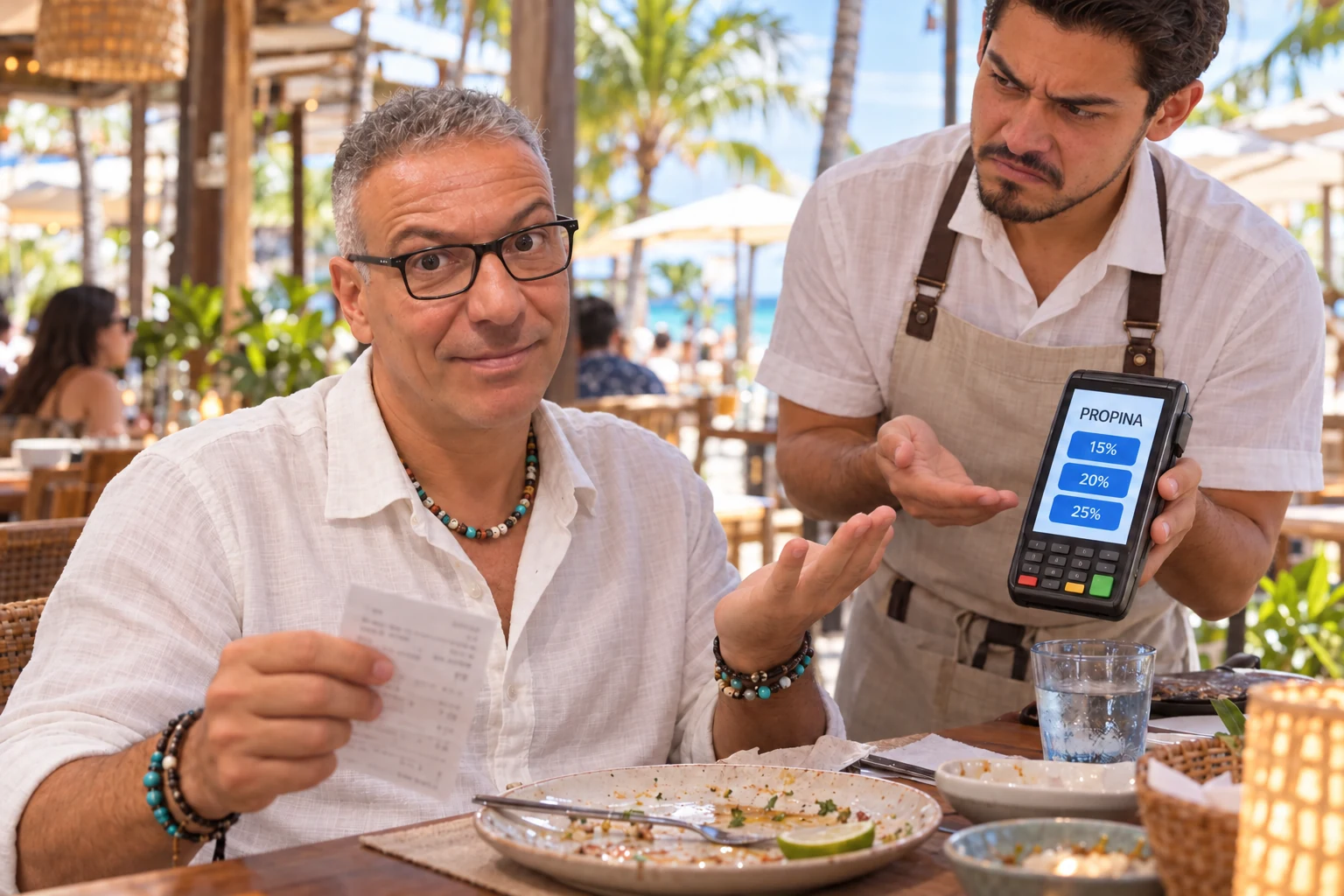
Forty minutes for a beer. Then, when the bill arrives, suddenly everyone is in a tremendous hurry. Especially to find out how much you are going to tip. It really happened to me here in Playa del Carmen. And whenever tipping comes up, that day comes straight back to mind. It is a subject that sparks plenty of debate, especially among people arriving from countries where tipping does not play such a central role in everyday life. We Italians, for example, already have our own little surprise encounters with cover charges and service fees. But those are different items: they should not be confused with a voluntary reward. The question that interests me is another one: is it right to ask for a tip, or does something about the gesture disappear the moment you ask? Because there is quite a difference between a cultural custom and a demand. And at the end of dinner, that difference can completely change the way you remember a place.
The Caribbean’s most patient beer
We were at a beach club in Playa: a nice place, with a restaurant where the food was actually quite good. I had been going there for years and knew the owner. That day, though, they were short-staffed and the service left a lot to be desired. It was not only the wait; their manner was pretty rude too. We ended up waiting forty minutes for a beer. At that point, you start wondering whether they ordered it from the bar or are waiting for it to finish fermenting. A bad day can happen. Anyone who works in hospitality knows that, and I know it well. But when the bill arrived, I decided the tip would also reflect the service we had received.
The bill was 2,700 pesos. I left 3,000: a 300-peso tip, roughly 11%. Not 20%, certainly. But it was not just a handshake and goodbye either. The waiter came back to the table with the bill and the money, visibly upset. He started shouting and accusing us of being stingy. After waiting so long for a beer, at least the lecture arrived right on time. I did not argue. I left, and I have never been back. More than four years have passed. But what really made me give up on that place was not only the waiter’s behavior. It was the owner’s response: in his opinion, the waiter was right. Three hundred pesos was not enough for the service. In my opinion, for that service it was already plenty. And that is the point: when customers have to justify why they did not leave enough, are we still talking about a tip?
I am not against tips. I am against the final exam
There are places where I am happy to leave 20%. When the service is attentive, professional and pleasant, I am glad to recognize it. Nobody needs to stare at me as though I were choosing their destiny on the payment terminal. A good waiter really can improve your evening. They know what to recommend, notice what is missing and handle a problem without dumping it in your lap. You can see that work, and it deserves respect. What I do not like is a percentage being expected no matter what. As if the service could be optional, but the tip could not. In Mexico, tipping is voluntary: it cannot be imposed or added to the bill without the customer’s consent. A suggested 10%, 15% or 20% remains a suggestion. It does not become a tax just because it appears on a screen. Even asking, though, requires a certain amount of tact. A polite question is one thing. Standing over the customer waiting for the “right” answer is another.
On the other side of the counter
I also live this story from the other side: I own cafés and work with skilled people who have experience and training. I know how much care good service requires, even when it is “only” a cappuccino. Many Italians living in Playa have visited my cafés. And very recently, someone called me to complain about a 10% tip that, according to him, he had not authorized. As far as I know, the team asks first. But his complaint makes me think about one point: asking does not automatically mean giving the other person the freedom to choose without pressure. Sometimes saying “no, thank you” in front of the person who has just served you is harder than it sounds. I do not think there is anything inherently wrong with politely asking whether a customer would like to leave something. But I do think it is essential that the customer can also say no without feeling judged. Some people leave nothing in our cafés. That is okay. If we are talking about a voluntary gesture, we have to accept it even when the answer is not the one we hoped for.
The customer should not have to fix everything with a wallet
I understand the workers’ point of view too. When people depend too heavily on tips to reach a decent income, every table can become a source of anxiety. But that should not make the customer responsible for every problem in the restaurant. The quality of the work, the organization and staff pay cannot all be dumped onto the little tray carrying the bill. Then there is a question people discuss less often: how are tips distributed? Let us take a purely hypothetical example. A restaurant takes in 10,000 dollars in one day and every customer leaves 20%: that is 2,000 dollars in tips. A significant amount. But that number alone does not tell us how many workers divide it or how much each person receives. So rather than making assumptions, it would be useful to talk about transparency. Who receives that money? How is it split among the dining room, bar and kitchen? Are there deductions? The customer’s recognition should follow a path that is clear to the people who earn it too.
Travel means understanding, not putting up with everything
When we visit a country, we have to take its customs into account. We cannot arrive with a suitcase and expect to rewrite all of them before aperitivo. That is why I advise my Italian friends to include a possible tip in their budget. If you already allow for an extra 15%, you can choose a restaurant more knowingly, without experiencing the bill as a plot twist. It is a way to plan your spending, not a mandatory percentage. And above all, it is not an invitation to reward rudeness, pressure or unauthorized additions. Respecting a culture does not mean giving up the right to choose. And respecting a customer means accepting that a “thank you” will not always come with the percentage we had in mind. I want to leave a tip because I had a good experience, not because I want to escape the restaurant without facing an interrogation. What about you? Have you ever left a tip more out of embarrassment than gratitude?